



A Hole in the Story
"An edgy, discomfiting look at the alpha males of journalism in the age of #MeToo."
— Kirkus Reviews, Kirkus Reviews (Starred Advance Review)
"The insights are subtle, as Kalfus writes with economical prose and avoids polemics even as Adam’s soul-searching leads to devastating honesty, allowing the reader to draw their own conclusions. This is sobering. "
— Publishers Weekly, Publishers Weekly (Advance Review)
"A Hole in the Story is nuanced, sure-footed, dryly funny, and unpredictable. If there were such a thing as a social-mores thriller, this would be it. "
— Alessandra Stanley, Air Mail (Recommended )
"Lit Hub: If you could choose a career besides writing (irrespective of schooling requirements and/or talent) what would it be? Ken Kalfus: Astronomer, especially if we disregard schooling requirements and talent—and also math skills and decent eyesight."
— Interviewed by Teddy Wayne, Literary Hub (Lit Hub Asks: 5 Authors, 7 Questions, No Wrong Answers )
"A former colleague’s #MeToo comeuppance forces a journalist to confront the self-serving narratives he has maintained about his own past. "
— Brendan Driscoll, Booklist (Starred Review)
"wise concision and wry humor"
— Dick Polman, Subject to Change, Substack ("I'm most interested in how my characters live in the historical moment.")
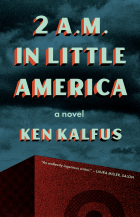
2 A.M. in Little America
2 A.M. in Little America
"Another tonally intricate triumph, this one about the bewilderment, alienation, and sheer strangeness of being a refugee.... A strange, highly compelling tale about what happens when American privilege and insulation get turned inside out."
— Kirkus Reviews (Advance review)
"He greeted me in a pronounced Bronx accent and a summer fedora, a can of bug spray in hand."
— Paul Starobin, The Washington Post Magazine (Our new national reality is now a dystopian novel)
"“2 A.M. in Little America” is a highly readable, taut novel. It pulls the reader into its world, and suggests that many interesting human complications await us at the end of the story called the United States of America."
— Héctor Tobar, The New York Times Book Review (A Novel Imagines the Next Wave of Refugees: Americans)
"2 A.M. in Little America belongs among the year’s biggest hits."
— Arianna Rebolini, Vulture (The Best Books of 2022)
"The chastening of America, with civil unrest, expatriates looking on in humiliation, and citizens of other countries savoring the once mighty country’s downfall, is the grim scenario Ken Kalfus envisions in his latest novel, “2 A.M. in Little America.” Whichever side one takes on the issues bedeviling America, readers familiar with his work will probably agree on this point: Kalfus is a perceptive guy. "
— Michael Magras, The Washington Post (Ken Kalfus gives readers an unsettling portrait of a humbled America)
"Kalfus paints a grim picture of where the U.S. is headed that tracks with the fever dreams being spun nightly by our real-world political commentators on both sides of the aisle. What is interesting about this book, however, is that, unlike similar cautionary novels such as The Handmaid’s Tale and The Road, the narrative never sets foot within the borders of the dystopia itself."
— Michael Landweber, The Washington Independent Review of Books (In a near-future dystopia, the refugees are us.)
"Heartbreaking and sobering, the dystopian novel 2 A.M. in Little America has the makings of a modern classic."
— Michelle Schingler, Foreword Reviews (Review)
"Ultimately, Patterson has to come to the same conclusion that “Marlise” realized decades earlier: to gain any semblance of agency in his life, he will have to become someone else entirely and leave his true identity behind. 'I would no longer be a migrant,' he says. 'I would no longer be an American.'"
— Alison Rochford, The Cleveland Review of Books (Disassociation and Diaspora)
"Meister des schelmischen Polit-Thrillers: Ken Kalfus (Master of the Mischievous Political Thriller)"
— Hannes Stein, Die Welt (Ein Szenario zum Ende Amerikas)
"This dissociation from objective reality is both reminiscent of Mersault’s existential detachment in The Stranger, and echoes the foggy, nihilistic path of Kafka’s protagonist in The Castle. There’s also a labyrinthine and dreamlike quality to Kalfus’s prose that recalls the surreal expressionism of movies like Brazil and Delicatessen:"
— Kirk Sever, Colorado Review (Review )
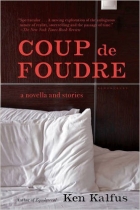
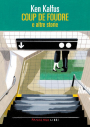
Coup de Foudre: A Novella and Stories
A new collection of short fiction, anchored by the full text of the title novella that appeared in Harper’s, a sometimes farcical, ultimately tragic story about the president of an international lending institution accused of sexually assaulting a housekeeper in a New York hotel. Other stories range wildly in theme, setting and tone. In “The Moment They Were Waiting For,” a murderer on death row casts a spell granting the inhabitants of his city the foreknowledge of the dates they will die. In “v. The Large Hadron Collider,” a judge distracted by the faint possibility of an affair must decide whether to throw out a nuisance lawsuit that raises the even fainter possibility that the entire Earth may be destroyed. “The Un-” is a nostalgic story of a young writer’s struggles as he tries to surmount the colossal, heavily guarded wall that apparently separates writers who have been published from those who have not.
"You can always count on a murderer for a fancy prose style, as Nabokov’s Humbert Humbert admitted, and in his spectacular novella “Coup de Foudre,” Ken Kalfus has created an equally articulate monster."
— Andrew Sean Greer, The New York Times Book Review (Charming Monster)
"Kalfus seems to revel in the consequences of dropping small bits of strangeness into an otherwise recognizable world—a park bench that traps its occupant until someone else comes to take their place, a curse that makes every inhabitant of a single town aware of the date on which they will die."
— Miriam M. Barnum, Harvard Crimson (A Clever Collection)
"And so it is with the novella as whole: the reader is swept along, horrified and entertained, and horrified to be entertained. The writing is masterful, especially considering that Kalfus manages to write so well while in the persona of a vain man who is trying and mostly failing to write well."
— Carolyn Daffron, Cleaver Magazine (Review of Coup de Foudre)
"gimlet-eyed observations, dazzling ideas and well-crafted characters whose exploits and predicaments flit between comedy, tragedy and downright absurdity"
— Malcolm Forbes, Financial Times (The Strange and the Sordid)
"overflows with ideas and oddities..."
— Publishers Weekly (Publishers Weekly)
"The stories are sharply original; he can be cool, hip, tragic. Kalfus sets the bar ambitiously high and one or two stories may not quite make it. Most linger in the mind, uncoiling, expanding. Witty, unsettling, sometimes weird, they sing from the page with intelligence, humour and style."
— Lee Langley, The Spectator (Between Duty and Desire)
"Kalfus ... showcases a dazzling versatility of style and imagination... devotees and newcomers alike will be richly rewarded by the author's impressive display here of rhetorical inventiveness and ingenious ideas."
— Booklist
"Almost my ideal of what the short story collection can do."
— Stuart Kelly, The Scotsman (Review)
"provocative explorations into contemporary culture"
— Michael Magras (Book Reporter)
"The short stories can be divided roughly into two categories. One is the earthy, realist-naturalist kind, historically tethered and psychologically bleak. It takes place in a version of our own reality -- for example, a provincial judge entertains fantasies of an affair. The other kind is more ribald and picaresque, the Borgesian- or Bolaño-inspired fantasias of mystical cities, improbable lost languages and enchanted parks benches in Paris."
— Vladislav Davidzon, Bookslut (An Interview with Ken Kalfus)
"Coup de Foudre - French for "thunderbolt" - operates on many levels, touching on poverty, race, immigration, AIDS, prostitution, and - through an unflinching discussion of genital mutilation - women's rights in Africa. "
— Joe Samuel Starnes, Philadelphia Inquirer (Portrait of Wild Energy)
"psychologically persuasive and intensely readable"
— Fiction Fan Blog (A master of the short story form)
Other Editions
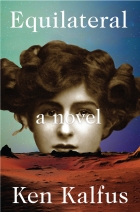
Equilateral
Nineteenth-century British astronomer Sanford Thayer has won international funding for his scheme to excavate an equilateral triangle, three hundred miles to a side, from the remote wastes of Egypt’s Western Desert. The fellahin put to work on the project can’t understand Thayer’s obsessive purpose. They don’t believe him when he says his perfect triangle will be visible to the highly evolved beings who inhabit the planet Mars, signaling the existence of civilization on Earth. Political and religious dissent rumbles through the camps. There’s also a triangle of another sort—a romantic one involving Thayer’s secretary, who’s committed to the man and his vision, and the mysterious servant girl he covets without sharing a common language. In the wind-blasted, lonely, fever-dream outpost known only as Point A, we plumb the depths of self-delusion and folly that comprise Thayer’s characteristically human enterprise.
"One of our most protean, politically engaged, and morally penetrating writers, Kalfus is also consistently playful in his fiction..."
— David Burr Gerrard, KGB Bar Lit Magazine (To Be Sure Of Things That Are In Fact Quite Mistaken: Ken Kalfus Interview)
"A straightforward setup with clear stakes, perhaps, but Kalfus' approach is a layered one: Equilateral's seemingly objective narrative voice remains so close to Thayer's perspective that it slowly manages to insinuate itself into the reader's consciousness, ultimately implicating us in Thayer's Victorian, colonialist worldview."
— Glen Weldon, npr.org (Stars In His Eyes, Sending Smoke Signals To Mars)
"Kalfus has a demonic imagination. The glamour of consistent disaster is recognizable in every line, every scene, every lacquered articulation: it is what we moderns like to call a neo-classical construct. I’m overcome by the splendor of what he’s done."
— Richard Howard
"And so builds the magic of Kalfus’ book. Indeed, as it progresses, it’s hard not to regard the novel with something akin to the awe with which the characters regard their project."
— Lian Callanan, Washington Independent Review of Books (Equilateral)
"When a new Ken Kalfus novel appears I stop eating, drinking, shaving and breathing until I finish it. Equilateral is one of his smartest and most ambitious books yet. It left me thinking and wondering well past my bedtime. "
— Gary Shteyngart, author of Super Sad True Love Story
"... eerie, Delphic, as stark and sere as the Great Sand Sea ..... a novel that, looking back from a safe distance, seems most accurately, and eloquently, to speak for the time in which it was written."
— Nathaniel Rich, The Daily Beast ("The 2013 Novel of the Year Is...")
"Kalfus maps the boundary between science and mysticism while simultaneously muddying, in a way the 20th century soon would, the previously bright line between scientific certainty and arrogant, self-deluded error."
— Kirkus Reviews (starred review)
"NASA wants to characterize the climate and geology of Mars, but it also wants to understand if life ever existed there... This very obsession, rampant in 19th-century Victorian culture, is the starting point for Ken Kalfus’s mesmerizing new novel Equilateral."
— Stacy Mickelbart, Kirkus Reviews (At the Edge of Visibility)
"Like Thayer's enormous triangle, the Big Idea underlying Equilateral the novel isn't illuminated until nearly its completion. It's a pretty neat trick for a novelist to pull off, to obscure the fact that what at first looks like an intricate fantasy novel actually contains pointed social commentary. When Kalfus finally strikes that match, we readers finally see the light."
— Maureen Corrigan, Fresh Air (Martians, Oil and a Hole in the Desert)
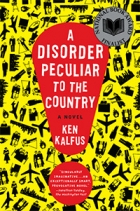
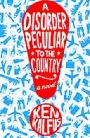
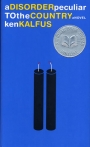

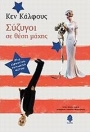


A Disorder Peculiar to the Country
Joyce and Marshall each think the other is killed on September 11 - and must swallow their disappointment when the other arrives home. As their bitter divorce is further complicated by anthrax scares, suicide bombs, and foreign wars, they suffer, in ways unexpectedly personal and increasingly ludicrous, the many strange ravages of our time.
- Finalist, National Book Award
- Best of 2006: Salon, Fresh Air, Seattle Times, San Diego Union-Tribune
"Without giving away the many things that happen in the book's closing pages, it betrays no secret to report that Joyce and Marshall don't reconcile. Kalfus is wise as well as smart, and he knows that's not the way the world works, at least not this world. But he grants a small measure of surcease to these two troubled people, with implications for the rest of us that the reader can contemplate with pleasure and relief as this pungent yet oddly lovely novel comes to its end."
— Jonathan Yardley, The Washington Post ("The War at Home")
"Through the interbleeding of public and private story lines and his lampooning approach, Kalfus has an evident mission: freeing the way we think about Sept. 11 and the war on terror from a ready-made mold, the rigid cast of a hardening historical view. If hyperbole can be weaponized anywhere in literature, it is here. Do the destructions of a home and the homeland bear similarity? Joyce, resenting her former belief that the country was protectively isolated, thinks, 'Someone had lied to them as shamelessly as a spouse.'"
— Art Winslow, The Los Angeles Times
"Kalfus avoids the easier targets and more obvious ironies of the era.... Joyce and Marshall see their escalating conflict not so much a metaphor for the global political situation as a mirror of it, which Kalfus presents both as an indictment of their boundless narcissism, and possible explanation of it. When Joyce wonders if their marriage 'had been destroyed by chance, by external events and fortuities that had reconfigured their personalities and made them profoundly, ridiculously, disgustingly incompatible,' it is, of course the most solipsistic sort of rationalization. Yet it's also plausible that the two would act out their anxieties of the evening news in the same way their children play "9/11" and draw pictures of bodies falling from flaming buildings.'"
— Jennie Yabroff, Newsday ("Terror on the Home Front")
"Kalfus skewers the pieties surrounding 9/11, but, having set his black comedy in the shadow of that national trauma, he reverently charts the powerful sway that world events briefly held over the lives of individual Americans. "
— The New Yorker (review)
The New York Times Book Review
Salon
Time Out New York
San Diego Union-Tribune
Denver Post
Boston Globe
San Francisco Chronicle
Seattle Times
Bloomberg
Pittsburgh Tribune Review
Commentary
Harvard Crimson
The Notre Dame Review
Financial Times
The Telegraph, review by Toby Lichtig, review by Alastair Sooke
Times Literary Supplement
Le Figaro Littéraire
Corriere della Serra
Letras Libras
Dziennik Polska Europa Sviat
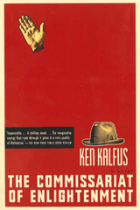
The Commissariat of Enlightenment
In the years between Tolstoy’s death in 1910 and Lenin’s in 1924, a young Russian propagandist learns how to manipulate film, foreshadowing the global empire of electronic images that occupies our imaginations today.
- A New York Times Notable Book of the Year
"A brilliant fusion of satire, science fiction and political commentary. Gogol is probably tearing his hair out, wishing he'd dreamed this up."
— Kirkus Reviews
"Kalfus is doing what most gifted historical novelists do: picking one of the moments when the star of modernity first appeared in the sky, then staring at it until its very gravity seems to increase, drawing into its orbit any stray comets in the vicinity. [He] is foreshadowing a revolution, just not the one we think. For all his contagious fascination with 20th century Russian history, he's finally less interested in Bolshevism's overthrow of the bourgeoisie than in film's overthrow of fiction, the eclipse of the novel by mere novelty."
— David Kipen, The San Francisco Chronicle ("From Russia with brains: A dying Tolstoy sparks brilliant riffs about the birth of modernity")
"Some scenes of action and description are realized so vividly that they almost have the force of hallucination. There is a recurrent vein of dark humor, and a grim sense of the lethal absurdities of totalitarian politics. No one in this book looks at anyone else's face or listens to anyone else's voice, except out of fear or coercion. People's lives are shaped by images -- religious icon, propaganda poster, film. So they become in the end not much distinguishable from images themselves, manipulated elements in the dynamic of history, looking forward to our own time and the welter of mind-softening images in which we live. ''The Commissariat of Enlightenment'' is a chilling novel, but the imaginative energy that runs through it gives it a rare quality of distinction."
— Barry Unsworth, The New York Times Book Review (Ambiguous Light)
"Astapov's distortions are the perfect metaphor for Kalfus's own special effects...Preoccupied with truth, media, history, and politics, this novel shows its mechanisms proudly."
— The New Yorker (review)
"It is always fascinating to me, as someone born in Russia, to watch an American absorb that country, or at least study the mind-set of its troubled people. To be repulsed by Russia, fine; to wish to exploit Russia, well, that's an understandable part of our capitalist credo; but to actually become Russian requires, among other things, intelligence, hubris, patience, fatalism, nicotine addiction, an angry gurgling somewhere above the solar plexus, and a fair shake of alcoholism. I have never met Ken Kalfus, author of the smart new novel The Commissariat of Enlightenment, so I do not know if I can ascribe to him anything but intelligence. Nevertheless, between this novel and the collection of stories entitled Pu-239 and Other Russian Fantasies, Kalfus has created a fictional, parallel Russia that reveals itself to the Western reader in all its soiled splendor. "
— Gary Shteyngart, Bookforum ("Lights, Camera, Comrades!")
"It Started With a Vision of Tolstoy's Death, Then Segued Into a First Novel," Mel Gussow, The New York Times
"Lights, Cameras, Agitprop!" Jon Fasman, Washington Post
The Guardian
"Stalin's Lies, Our Lies," Laura Miller, Salon
"The Camera Lies," Peter Millar, The Times
Minneapolis Star-Tribune
Philadelphia City Paper
mostlyfiction.com
de Volkskrant
Pu-239
And Other Russian Fantasies
Spanning a century of Russian history, a book of short stories that include “Pu-239,” the source for the HBO movie.
- Finalist, PEN/Faulkner Award
- A New York Times Notable Book of the Year
- Village Voice Writer on the Verge Award
- Pushcart Prize
"...so full of pleasure and wonder from sentence to sentence and page to page that it touches the reader physically, as Borges once put it, 'like the closeness of the sea or of the morning.'...[Kalfus's] writing is alternately sparse or lush where appropriate, and Kalfus...exudes an uncanny authenticity...Kalfus inhabits the consciousness of all his disparate characters with equal adroitness. The stories themselves have a cumulative power, achieving an epic vision of a country and its past as well as an intimate portrait of individual lives."
— Andrew Roe, San Francisco Chronicle (Piecing Together Fragments Of Russia's History in Short Stories)
"Kalfus conveys a sense of Soviet and post-Soviet life in the stories here -- you'd think he'd lived there for decades. Kalfus is that rare writer of fiction whose passages of description feel like action; it's as if he were injecting his readers with a serum that renders them, in a rush, intimately familiar with the texture of the Russian experience."
— Salon (review)
"It is exceptionally difficult for a foreigner to write fiction about Russia and get it right. Ken Kalfus gets its right. Again and again. In this new collection of short stories, Kalfus excavates the subtleties of the Russian psyche and soul with understanding and sympathy. and a fair measure of irony."
— Russian Life
"['Birobidzhan'] is a masterpiece: wrenching, tender, harrowing and suffused with the sad comedy of an idealistic intensity that it refuses to mock.... "
— Jim Shephard, The New York Times Book Review ("Dead Souls: Ken Kalfus's fiction portrays the long-running dismal farce that was Soviet Russia")
"Kalfus prove[s] himself to be one of those rare writers who manages to tackle lofty issues of transnational culture and capitalism with a gentle humanist touch, making his stories at once intellectually provocative and emotionally satisfying."
— Booklist
"Kalfus is not a political writer, really. He loves to tell stories, loves imagining other people's lives and experiences, and we can sense this in the delicate unraveling of each plot, of each sentence. There is, among us, a storyteller - how rare a gift this is!"
— Keith Gessen, The Boston Book Review ("A Storyteller Among the Ruins")

Thirst
The first book by Ken Kalfus, a collection of short stories: Parisian sex museums, Third World deluges, existential dread and existential baseball. Newly reissued by Milkweed Editions.
- A New York Times Notable Book of the Year
- One of the Village Voice Literary Supplement’s 25 Favorite Books of the Year
- Salon.com Book Award
"Kalfus veers between whimsical postmodern playfulness and a darker realism in the fourteen stories of his skilled, versatile first collection.... Ambitious and daring, with smart, fluid prose and an abundance of surprises."
— Publishers Weekly
"Throughout this collection, the door is open to such unsettling ambiguity; always a tantalizing ''perhaps'' is in play..... Ken Kalfus lights his stories with this fundamental strangeness. The displaced figures in Thirst drift through worlds that are at once astonishing and familiar. They'd like to wake up in their own beds after a good night's sleep, but even that blessing would, we suspect, have the word ''perhaps'' in it somewhere."
— Ron Carlson, The New York Times Book Review ("Invisible Malls, Imaginary Baseball: Anything is plausible in one or another of these short stories")
"Kalfus is one of those rare writers whose travels haven't colored his prose with cosmopolitan cynicism... He reminds us that sometimes the really significant truths are those found closest to home."
— Dwight Garner, The Village Voice
"A dazzling debut...With his amazingly eclectic story collection, Ken Kalfus emerges as a major literary talent...It's exhilarating to discover a young writer with so much range and so little self-consciousness about exploiting it."
— Laura Miller, Salon ("The Amazing Voices of Ken Kalfus")
"An intelligent and playful collection of short stories that will move readers by engaging their sense of wonder and joy of exploration...Ken Kalfus resorts to fiction to accommodate what life can't accommodate - imaginary meanderings that the physical, phenomenological world makes impossible. He keeps contradictions and ambivalences in abeyance, forcing confrontation of possible and impossible worlds. He uses fiction, among other things, to address problems, without seeking to resolve them."
— Boston Book Review